The standard is an internationally recognized framework that helps companies calculate and transparently report greenhouse gas emissions across the full life cycle of a product.
Product Carbon Footprint according to the GHG Protocol
Built on the GHG Protocol Product Life Cycle Accounting and Reporting Standard. Recognize, analyze and act sustainably from raw materials to recycling.



Product Carbon Footprint
Efficient distillation.
From the corporate footprint to the Product Carbon Footprint.
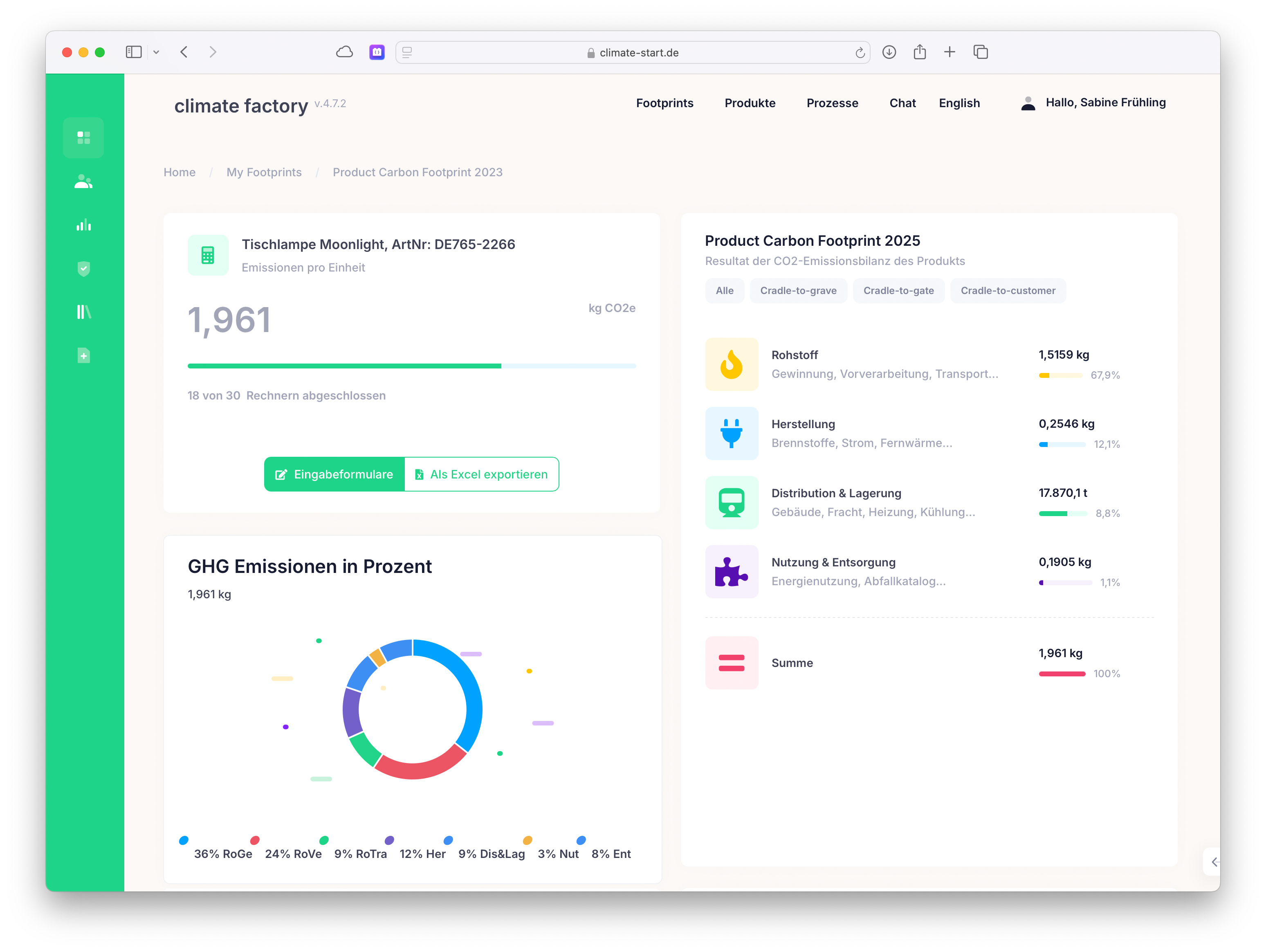
We distill the comprehensive carbon footprint of your company into detailed, product-specific analyses. With our CCF software and the expertise of our team, we turn complex data into transparent PCF reports for a holistic sustainability strategy. Our proven methodology combines deep business understanding with advanced calculation methods to deliver a precise Product Carbon Footprint that is tailored and traceable. With our specialized Corporate Carbon Footprint software, we go deep into your processes, supply chains and data. This comprehensive analysis highlights reduction potential and brings proven emission-reduction practices to the surface. Our team uses internal PCF calculation tools to create tailored reports for your products. We do not rely on generic off-the-shelf software. Every assessment is aligned to the specifics of your business.
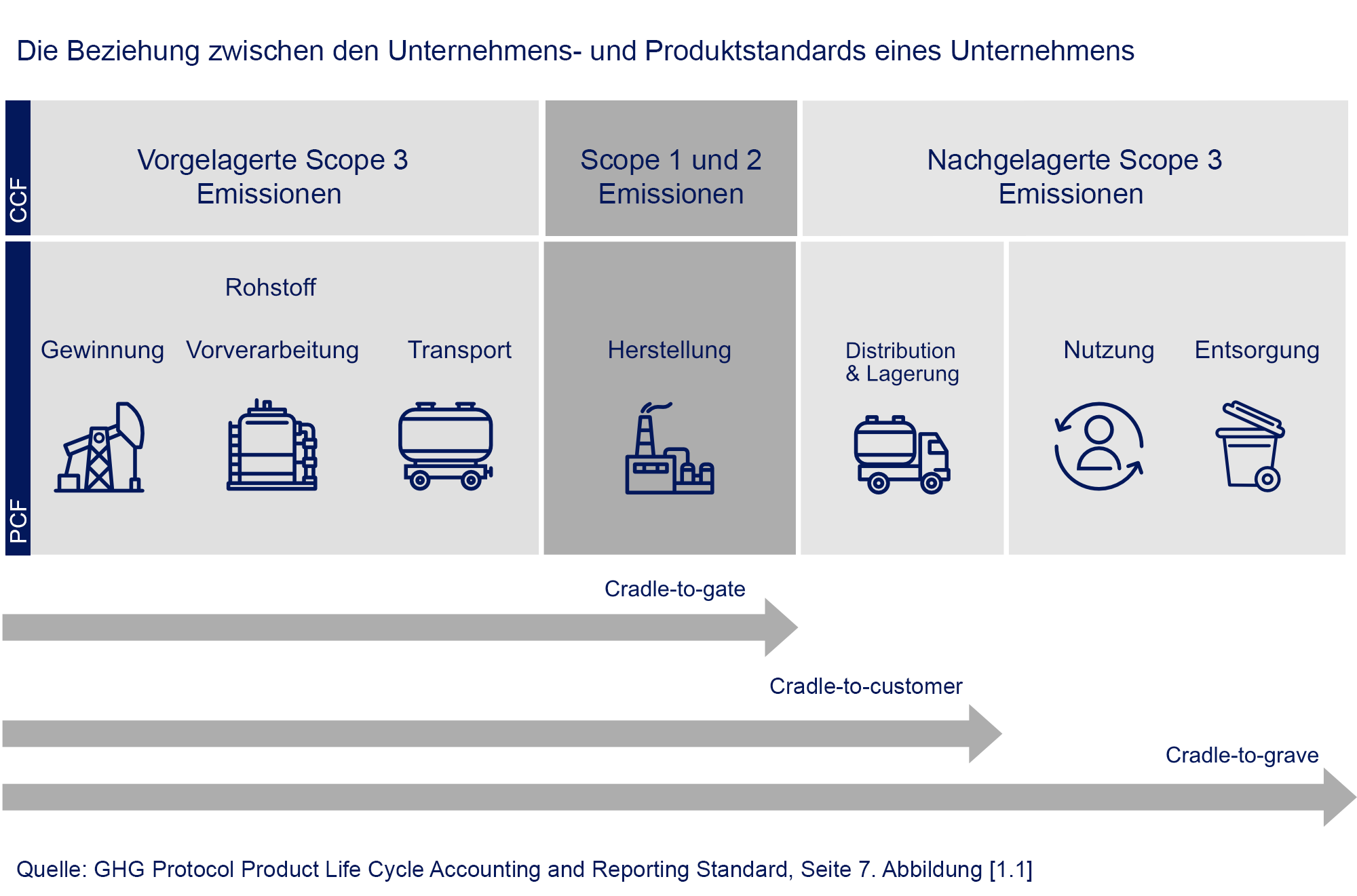
Discover the environmental impact of your products with the GHG Protocol Product Life Cycle Accounting and Reporting Standard and pave your way toward a more sustainable future.
Life cycle assessment
- We cover every stage of your product life cycle, from raw material extraction to disposal, to provide a complete view of climate-related emissions.
Internationally recognized standard
- Our methodology is based on the globally recognized GHG Protocol, giving your climate reporting credibility and trust.
Precise data generation
- Benefit from precise calculated metrics that support sustainable and strategic decision-making.
Transparent reporting
- With clearly structured PCF reports, we provide documentation that is understandable and fit for internal and external stakeholders.
Request a non-binding consultation now
Register for a free and non-binding initial consultation and find out how to take your climate management to the next level with Climate Extender.
Contact form
Certified according to ISO 14064-1 & the GHG Protocol
DIN EN ISO 14064-1 & Greenhouse Gas Protocol "A Corporate Accounting and Reporting Standard"
Climate Start meets all requirements for accounting methodology and the determination of greenhouse-gas-relevant information in accordance with DIN EN ISO 14064-1 and the Greenhouse Gas Protocol "A Corporate Accounting and Reporting Standard" for calculating a complete Corporate Carbon Footprint across scopes 1, 2 and 3.
Our Service
Experience a full-service approach built on intensive preparation, accurate data collection and precise analysis. With us, your product PCF becomes a compelling basis for sustainable decisions.

The Award Winner
Green Innovator of the Year 2024
Climate Extender supports companies in establishing transparent greenhouse gas management. Its audited software covers data collection and accounting, the analysis of emissions hotspots, and the development of reduction measures. Climate Extender makes reliable emissions data part of the value chain.
The Award
"With the help of its tool, Climate Extender supports customers on their path to climate neutrality and enables companies not only to record their CO2 emissions, but also to visibly reduce them."

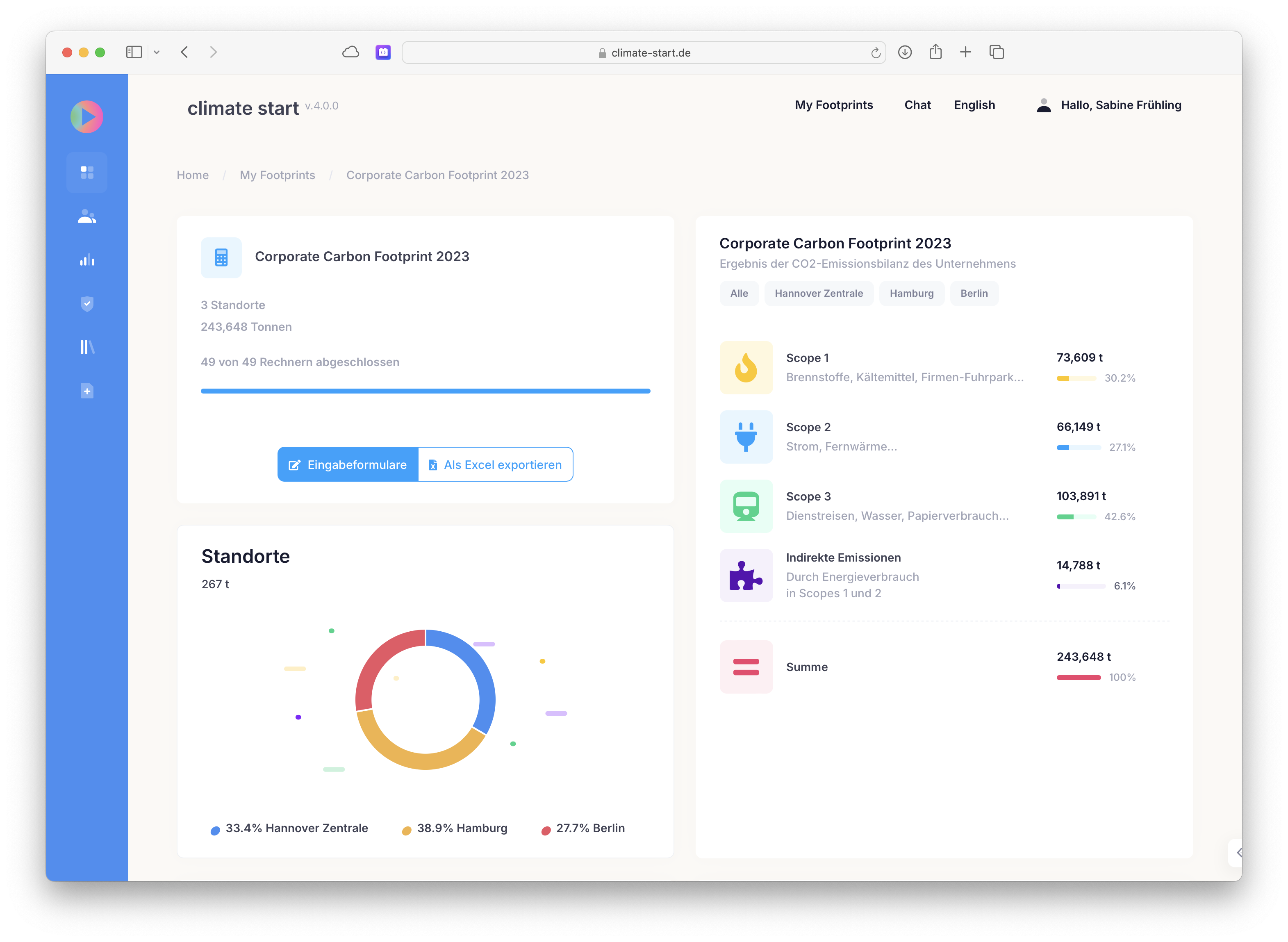
The CO2 Footprint Calculator for Companies
The audited software for Corporate Carbon Footprints according to DIN EN ISO 14064-1 and the Greenhouse Gas Protocol. For Scope 1, 2 and 3, clear documentation, and results that can be used across the company.
Climate Start reflects the methodological requirements for accounting and determining greenhouse gas-related information for a complete Corporate Carbon Footprint across Scope 1, 2 and 3. This provides a reliable basis for internal analyses, external requirements, and documented results.
More Information...
Service as a Result (SAAR)
A partnership in CO2 reporting
At Climate Extender, we go beyond traditional software solutions. We believe in providing service as a result, which means we do not just provide tools, we deliver outcomes. Our team works closely with you to ensure accurate CO2 tracking, comprehensive emissions reporting and compliance with the latest GHG and ISO standards. We are more than a software provider. We are your sustainability partner.
A Software To Be Proud Of
70,000+
EMISSION FACTORS
20 Million+
TONS OF CO2e WE CALCULATE PER YEAR
Umwelt Bundesamt
UBA is Germany's main environmental protection agency. Its task is to ensure that people have a healthy environment with clean air and clean water that is as free of pollutants as possible.
ecoinvent
ecoinvent is a non-profit association based in Zurich, Switzerland, dedicated to providing high-quality data for sustainability assessments worldwide.
EXIOBASE
EXIOBASE is a global, detailed multi-regional environmentally extended supply-use table and input-output table. It was developed by harmonizing and detailing supply-use tables for a large number of countries in order to estimate emissions and resource extraction by sector.
GHG Protocol
The GHG Protocol establishes comprehensive, globally standardized frameworks for measuring and managing greenhouse gas emissions from private and public sector operations, value chains and mitigation actions.
Request a non-binding consultation now
Register for a free and non-binding initial consultation and find out how to take your climate management to the next level with Climate Extender.
Contact formFree, non-binding initial consultation
Dipl.-Ing. Frank Huschka
Founder of Climate Extender
If you have any questions or any special requirements, please feel free to contact me.
You can call me.
+49 5108 8794185
or write me an e-mail.

Contact
Do you have any questions?
Would you like to set up a Corporate or Product Carbon Footprint?
Send us a short note about your project. We will get back to you promptly.
E:
Contact
Phone: +49 5108 8794190
Questions and Answers
-
What is the GHG Protocol Product Life Cycle Accounting and Reporting Standard?
-
Why is applying this standard important for companies?
It helps organizations assess environmental impact systematically, supports sustainable decision-making and strengthens trust among customers, investors and other stakeholders.
-
Which phases of the product life cycle are covered?
All phases are included, from raw material extraction to production, use, disposal and recycling.
-
Who developed this standard?
It was developed by leading organizations such as the World Resources Institute and the GHG Protocol Initiative.
-
What is the GHG Protocol?
The GHG Protocol is a widely used standard for measuring and managing greenhouse gas emissions. It provides a framework and guidelines for organizations to measure and report emissions and supports them in developing strategies to reduce their carbon footprint. The protocol was developed by the World Resources Institute and the World Business Council for Sustainable Development and is used by companies, governments and other organizations around the world. It covers three scopes of emissions: Scope 1 for direct emissions from owned or controlled sources, Scope 2 for indirect emissions from purchased electricity, heat and steam, and Scope 3 for indirect emissions across the value chain, including suppliers, customers and transport.
-
Is the standard recognized worldwide?
Yes. The standard is used and recognized globally to measure emissions and create comparable reports.
-
Can any company apply this standard?
Yes. Organizations of any industry and size can benefit from a systematic emissions assessment.
-
How does the standard contribute to sustainability?
By measuring and reporting emissions transparently, companies can implement targeted reduction measures and operate more sustainably.
-
Does the standard also support clear communication to external stakeholders?
Yes. The clear and traceable presentation of data improves credibility and trust among investors, customers and other stakeholders.
-
How does the standard support a competitive advantage?
Companies can present their environmental performance more clearly, positioning themselves as responsible and forward-looking, which creates a clear market advantage.
-
How does the Product Life Cycle Standard differ from the corporate emissions standard?
The product standard focuses on the specific life cycle of an individual product, while the corporate standard covers the total emissions of an organization.
-
Which methodology is recommended for data collection?
It is recommended to collect both primary and secondary data and to use life cycle assessments as the basis for accurately calculating emissions.
-
How are Scope 3 emissions integrated into product life cycle accounting?
Emissions that arise before the actual production process, such as raw material extraction, and after use, such as disposal, are typically captured as Scope 3 emissions and integrated into the assessment.
-
How important are data quality and uncertainty in emissions accounting?
High data quality is essential. Uncertainty should be reduced through sensitivity analyses and transparent documentation of methodology in order to produce reliable results.
-
How do companies identify emission hotspots along the value chain?
Detailed analysis of the individual life cycle phases makes it possible to identify areas with particularly high emissions and use them as targets for optimization.
-
What challenges arise when collecting data across different life cycle phases?
Differences in data availability, regional variation and methodological approaches can make comparisons harder. A standardized framework helps achieve consistent results.
-
How can the standard be integrated into existing sustainability reporting?
Companies can incorporate the results of product life cycle analyses directly into broader sustainability reporting and use them to support strategic decisions.
-
What role does life cycle assessment play in capturing indirect emissions?
Life cycle assessment makes it possible to capture indirect emissions, often part of Scope 3, in a comprehensive way, where they are often underrepresented in traditional reporting.
-
Are there industry-specific adaptations within the standard?
Yes. The standard is flexible enough to account for industry-specific characteristics and can be supported by additional guidance and interpretation aids.
-
How is the success of implementing the standard measured?
Success is reflected in the accuracy of the collected emissions data, the successful identification of reduction potential and the integration of results into strategic business decisions.
Request now
Register for a free and non-binding initial consultation and find out how to take your climate management to the next level with Climate Extender.
Contact form